
Voice of Customer Is Broken at Most SaaS Companies — Here's Why
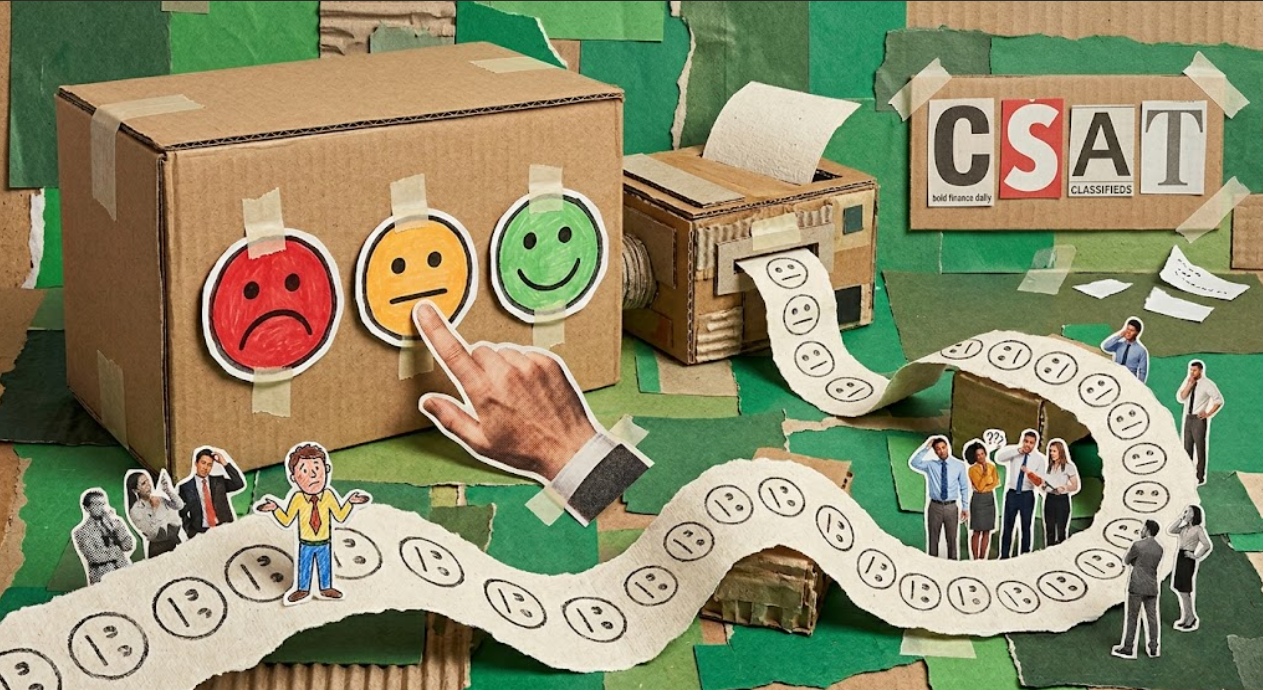
There's a particular kind of quarterly slide that I've seen in more CS and product reviews than I'd like to count. It shows a distribution of customer feedback scores — usually NPS, sometimes a themed satisfaction survey — with a note about the response rate and a few selected verbatim comments underneath. It tends to live in the "voice of customer" section of the deck. And it tends to sit there, nodded at, and then the conversation moves on.
I don't say this to be uncharitable about the people running those reviews. The slide usually reflects a genuine attempt to collect and present customer feedback. The problem is that it represents the wrong end of a VoC programme — the collection and presentation of data — without the part that actually determines whether VoC is useful: a clear mechanism for turning that data into decisions that change how the product or the customer experience works.
Most Voice of Customer programmes I've encountered are better at gathering signal than acting on it. The feedback loop is, in many cases, not a loop at all — it's a pipe that ends at a dashboard and goes no further.
How VoC programmes tend to be built backwards
The typical VoC programme starts with a method. Someone decides to run NPS — because it's standard, because someone read about it, because the board is asking for it. Or they run CSAT on support tickets. Or they build a quarterly customer survey with twelve questions chosen by a committee. The method comes first; the question of what decisions the data should inform comes later, if at all.
This matters because the method shapes the data you collect, and the data you collect shapes what decisions are even possible. If you're running NPS without a closed-loop follow-up process, you know who your detractors are but you don't know why — and you don't have a mechanism to engage them before they churn. If you're running a quarterly survey without a routing process for the responses, you know that customers care about X and Y, but nobody's job is to do something about X and Y within a defined timeframe.
The backwards build produces a VoC capability that can answer "what are customers feeling?" but not "what are we going to do about it, by when, and how will we know it worked?" The first question is interesting. The second is the one that justifies the investment.
The three gaps I see most consistently
The follow-up gap. Most feedback collection ends at collection. A customer submits an NPS response and receives an automated thank-you. The response goes into the system, contributes to the score, and nothing further happens unless the score was very low — and even then, the follow-up is inconsistent. The customers who give a six or seven — ambivalent rather than actively unhappy — tend to get nothing. Those are exactly the customers most at risk of quietly becoming an eight for a competitor.
The fix for this is a closed-loop process: every detractor (and many passives) should receive a follow-up that acknowledges the feedback and asks for the specifics. Not a generic "thanks for letting us know" — a genuine attempt to understand what would need to change. Building that process, and ensuring the CS team has the capacity and tooling to run it, is a CS Ops design problem.
The routing gap. Customer feedback touches multiple functions — product, CS, support, marketing — but in most organisations it doesn't reliably reach all of them. Product themes that emerge from NPS verbatims might be summarised in a quarterly slide, but they're not systematically routed to the product team in a form they can act on. Support patterns that appear across multiple feedback submissions might be visible to the CS leadership but not to the person who owns the support knowledge base.
A VoC programme that doesn't have clear routing logic — this type of feedback goes here, triggers this process — is collecting signal and letting most of it evaporate. Building the routing is partly a process design problem and partly a tooling problem, but it requires someone who can see across the functions and map where the feedback needs to go.
The accountability gap. Perhaps the most common failure: feedback is collected, surfaced, discussed in a review — and nothing changes, because nobody's job it is to change it. The VoC function can present the data; it can't make the product team prioritise a feature, or make CS leadership rebuild an onboarding stage, or make support update a process. Without defined ownership and timescales on the action items that come out of customer feedback, the feedback loop closes in theory but not in practice.
This is partly a culture and governance question — who in the organisation has the authority to turn VoC insights into committed changes? But it's also a CS Ops design question: what does the mechanism look like that translates insight into an owned action item with a timeframe and a way to verify it was done?
What a working feedback loop actually looks like
A functional VoC programme has a few components that most implementations lack.
It has a defined decision target before collection starts. "We're collecting this data so that we can make a decision about X" is the starting point — not "we're collecting this data so that we have it." The decision target determines what you ask, who you ask, and what a useful response rate looks like.
It has a closed-loop process with SLA. Every piece of feedback above a threshold triggers a defined follow-up within a defined timeframe. Low NPS scores: follow-up call within five business days. Specific feature requests submitted via survey: acknowledged with a response on timeline within two weeks. The SLA creates accountability and signals to customers that their input actually goes somewhere.
It has a quarterly synthesis rhythm, not a quarterly report rhythm. The difference: a report shows data. A synthesis extracts themes, assigns them to owners, and produces a small number of committed actions with timescales. The synthesis should be a working session — someone with authority to commit the relevant functions to action in the room.
Questions worth sitting with
If your organisation runs a VoC programme, these are worth taking into the next review conversation:
What was the last significant product or service change that was directly traceable to customer feedback — with a clear line between the feedback received and the decision made? If you can't name one from the last two quarters, the loop probably isn't closing.
What happens to a customer who submits a negative survey response and never hears from you again? From their perspective, the feedback they gave disappeared. That's the experience most customers have with most VoC programmes. It's not the experience that builds trust.
Who owns the gap between "feedback collected" and "change made"? If the answer is "everyone in general," it's nobody in particular. A named owner with defined authority is the prerequisite for the loop closing.
The short version
Voice of Customer programmes are built backwards at most SaaS companies — they start with a collection method rather than a decision target, and they optimise for the quality of the data collected rather than the quality of the action taken on it. The three gaps that consistently prevent VoC from being useful: no closed-loop follow-up with SLA, no routing process that moves feedback to the right function in a usable form, and no defined ownership of the action items that come out of synthesis. Fixing these requires process design and CS Ops infrastructure — a way to translate customer signal into committed, accountable changes rather than quarterly slides that get nodded at and moved past.
Where Pivotal Path comes in
Pivotal Path works with CS and CS Ops teams who are rebuilding their customer feedback infrastructure — from the collection design through to the closed-loop process and the synthesis rhythm. If your VoC programme is generating data but not decisions, get in touch
James Hayward-Zhu is the founder of Pivotal Path, a Customer Success and CS Ops consultancy working with SaaS businesses at the growth stage.