
CS and Product: Closing the Feedback Loop That Usually Stays Open
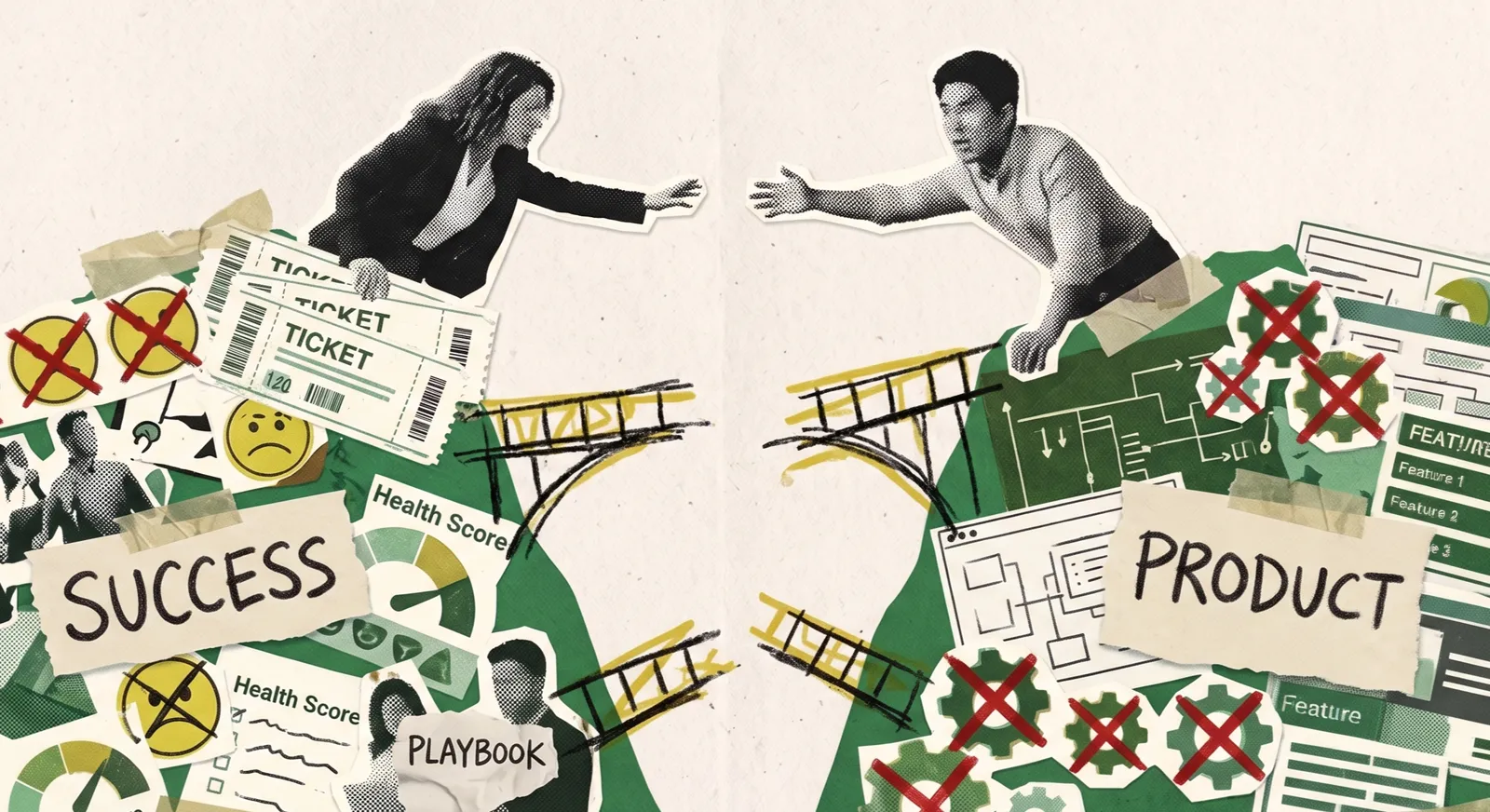
Most SaaS companies have some version of a process that sounds like: "customer feedback from CS goes to product, product considers it for the roadmap, product delivers things customers asked for." The reality is usually rather different.
Customer feedback from CS goes into a support tool, a Slack channel, a shared spreadsheet, or an informal verbal conversation. Product receives some of it, some of the time, from some CSMs, in formats that vary enough to make systematic analysis difficult. What makes it to the roadmap is shaped by the volume of feedback, the urgency with which it's presented, and whether the feedback happens to align with something product was already planning. And what gets delivered is communicated to CS either formally (in a release note or a changelog) or informally, through the network of CSMs who happen to be plugged in.
The feedback loop is technically there. It leaks at every stage.
Why this matters more than most CS teams realise
A broken CS-product feedback loop has two costs that don't always get counted together.
The first is the product cost: a roadmap that underweights customer problems because the signal coming from the field is noisy, inconsistent, and hard to prioritise against. This is usually visible to product teams as a chronic sense that the feedback they get from CS isn't actionable. Too many individual feature requests, not enough pattern recognition about the underlying problem the requests are pointing to.
The second is the CS cost: a team that is repeatedly asked by customers about features they've requested and has nothing meaningful to say. CSMs who can't close the loop with customers about whether their feedback landed (who can only say "I'll pass that on") lose credibility over time. And customers who submit feedback and never hear what happened with it stop submitting feedback. The channel dries up, and the company loses a signal that was never perfect but was genuinely valuable.
Where the loop breaks
There are four places the loop characteristically breaks, and fixing only one of them doesn't close the circuit.
Collection. Feedback collection in CS is usually informal. CSMs hear things in calls, in check-ins, in business reviews. Some of those things get logged. Some don't. What gets logged depends on whether the CSM thinks it's worth logging, what logging system is available and how friction-free it is, and whether there's a clear definition of what counts as product feedback versus what counts as a support issue.
Without a structured collection process (agreed formats, agreed channels, a habit of capturing feedback in calls rather than after them), the raw material for the feedback loop is inconsistent by design.
Synthesis. Individual feedback items are almost never what product needs. What product needs is pattern recognition: not "customer X asked for feature Y" but "across 12 conversations this quarter, the same underlying friction point came up in the following ways." That synthesis requires someone to do it, to read across the feedback data, identify themes, and represent the pattern coherently.
Most CS teams don't have a synthesis step. The feedback goes from collection to product as individual items, and the volume makes it genuinely difficult for product to do the pattern recognition themselves. The result is that the feedback feels unactionable, and the connection between CS input and roadmap output weakens.
Routing. Not all CS feedback belongs on the product roadmap. Some of it is a support issue. Some of it is a configuration question. Some of it is a reflection of a mismatch between what was sold and what was delivered, which is a sales or onboarding issue, not a product issue. CS teams that route everything to product are adding noise to a channel that should carry signal.
A triage step (deciding what category of response each piece of feedback deserves, before it goes anywhere) improves the quality of what product receives and reduces the backlog of "feedback" that never goes anywhere.
Closing the loop back. The most commonly skipped step is communicating back to customers when their feedback has influenced something. This is partly a process gap (there's no system that tracks the link between a piece of customer feedback and a release item) and partly a cultural one. Product teams often don't think of closing the loop as their job. CS teams are often not told what shipped or why.
The customer who sees a feature they asked for, and knows they asked for it, becomes an advocate. The customer who submitted the same request and never heard anything doesn't even know their input had any effect. One of those states builds a relationship; the other erodes it.
What closing the loop requires
A functional CS-product feedback loop needs three things to be in place simultaneously.
A structured collection format. Not a feature request form. Those create the wrong frame. Something lighter: a consistent way for CSMs to capture the underlying problem a customer is experiencing, with enough context (which segment, how often mentioned, what's the workaround they're using) to make it useful for pattern recognition.
A synthesis cadence. Someone, on a regular schedule, reads across the feedback collected and produces a synthesised summary for product. This might be a monthly CS Ops report, a quarterly theme document, or a standing agenda item in the CS-product joint meeting. The format matters less than the regularity and the commitment to doing the synthesis work rather than just passing raw feedback.
A close-the-loop protocol. When something ships that was informed by customer feedback, there should be a mechanism to communicate that back, to the CSMs who collected the feedback, and ideally to the customers who raised it. This doesn't need to be elaborate. A simple record of "this release addressed the feedback we collected around X, from these accounts" is enough to allow CSMs to have a closing conversation.
The CS Ops contribution
CS Ops sits at the intersection of CS and the rest of the business. The CS-product feedback loop is exactly the kind of cross-functional process that CS Ops is designed to improve.
That includes the collection infrastructure (the format, the channel, the prompt), the synthesis function (who does it, when, in what format for product), and the close-the-loop process (what product commits to communicate back, and how that communication reaches the customer).
It also includes the honest conversation between CS and product about what the feedback data is actually worth. CSMs tend to over-weight the urgency of customer requests because they're hearing them directly, with emotional context. Product teams tend to under-weight them because they're receiving them without that context. CS Ops can create a more productive middle ground by being the layer that adds rigour to the signal without stripping the context.
Questions worth sitting with
How would you describe the CS-product feedback loop in your organisation to a new joiner? If you had to draw it on a whiteboard, where would you put the question marks?
When was the last time a customer knew that something they'd asked for had been built? How did they find out?
What's the ratio in your current feedback collection of "individual feature requests" to "synthesised problem patterns"? Is that ratio working for product, or against it?
The short version
The CS-product feedback loop leaks at collection (informal, inconsistent), synthesis (usually skipped), routing (everything goes to product regardless of category), and close-the-loop (rarely happens at all).
Fixing the loop requires a structured collection format, a synthesis cadence, and a close-the-loop protocol. CS Ops owns the infrastructure; the cultural shift is treating the loop as a joint CS-product responsibility, not a one-way pipe.
Where Pivotal Path comes in
Pivotal Path helps CS and product teams design feedback loops that actually close, from collection format to synthesis cadence to the close-the-loop mechanism that turns feedback into advocacy. If your CS feedback goes in and nothing comes back out, we can help fix the circuit.
Working on this in your business?
We help UK SMEs and scale-ups turn this kind of thinking into action.
Read next

The Sales-to-CS Handover Is Broken, and Both Teams Know It
Voice of Customer Is Broken at Most SaaS Companies: Here's Why

What your offboarding process reveals about your customer success function

Why CSMs Burn Out, and What the CS Ops Infrastructure Has to Do With It

Scaled CS: what it actually means and when you need it