Escalation Management in CS: The Difference Between a Designed Response and a Panicked One
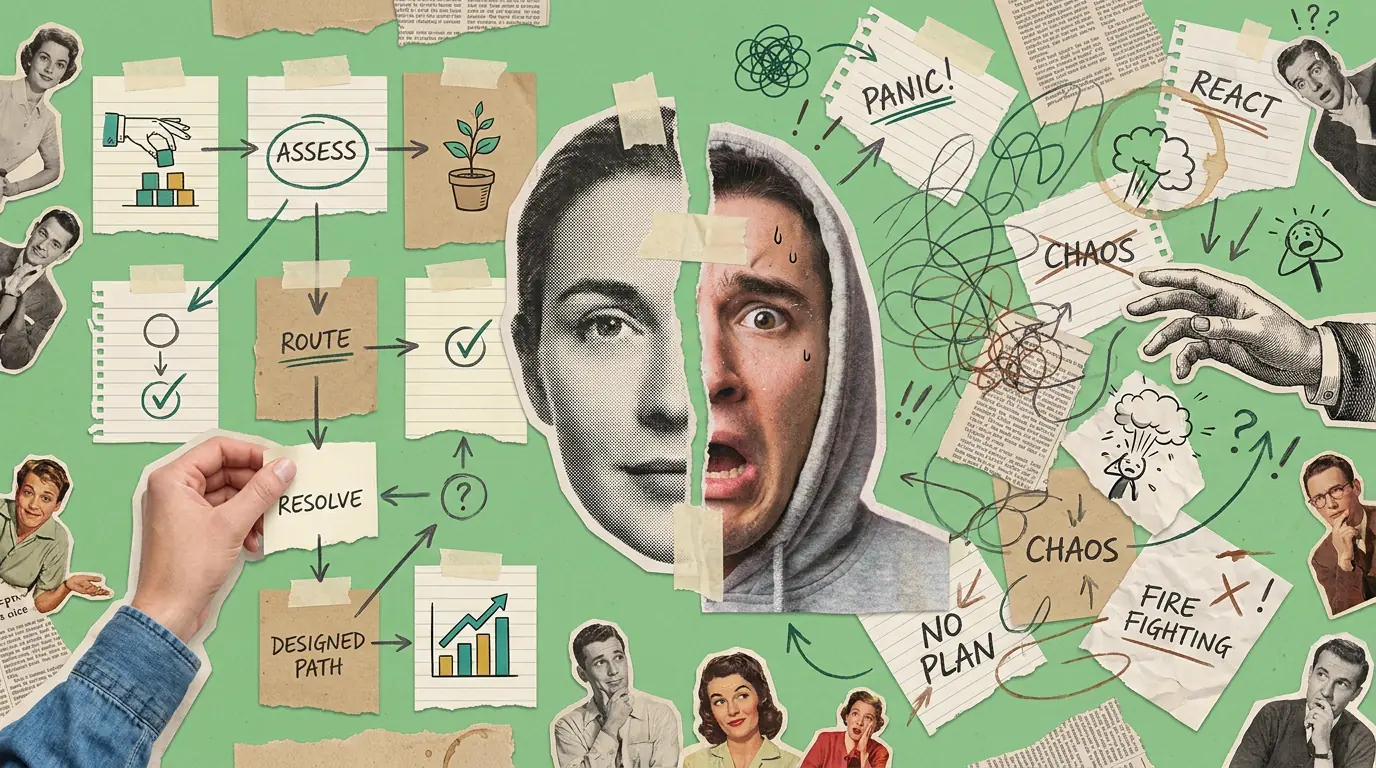
The first time most CS teams design an escalation process is when they're in the middle of one.
A customer has gone from amber to red in the space of a week. There's been a product incident, or a missed delivery, or someone senior at the customer's organisation has sent a pointed email. Suddenly everyone is in a room (or on a call) working out who does what. The CS team is fielding messages. Someone from leadership is asking for a status update. The CSM is trying to manage a frustrated customer while simultaneously trying to find out what actually went wrong.
The response that emerges from this moment is usually fine. The problem is that it gets logged as a precedent ("this is how we handle escalations") rather than as a prompt to build something better. The next time something escalates, the team improvises again, usually in a way that's slightly different from the last time, and the gap between what was handled well and what wasn't is never quite closed.
Why improvised escalation is a structural problem
Escalations are high-stakes by definition. They arrive under conditions of information scarcity, time pressure, and heightened customer emotion. Those are precisely the conditions in which having a clear, pre-agreed structure is most valuable, and most teams go into them without one.
The consequences are predictable. Ownership is unclear, so things get handed off too many times. The customer gets conflicting messages because different people are communicating independently. Resolution happens, but the learning doesn't, because the team is already onto the next thing.
There's also a subtler problem. When escalation management is improvised, the definition of an escalation drifts. One CSM escalates something that another CSM would have handled independently. What triggers an escalation (in terms of urgency, risk level, who gets involved) varies by individual judgment rather than shared criteria. That inconsistency creates its own problems: accounts that should have been escalated earlier aren't, and accounts that didn't need senior involvement get more than they needed.
The four-phase model
A designed escalation process has four phases, and the most important one is the one that happens before anything goes wrong.
Detection. The earliest phase is recognising that an account is on a trajectory that warrants a different level of attention. Most escalation frameworks start here, but detection is only useful if the signals are defined in advance. Which risk signals in the health score indicate a potential escalation situation? What customer behaviour patterns (declining engagement, unexplained drop in usage, a sudden flurry of support tickets) should prompt the CSM to elevate their attention level before the customer says anything? Detection that relies on the CSM's intuition is better than nothing, but it's not scalable and it's not consistent.
Contain. Once an escalation is underway, the first job is to stop the situation getting worse, not to fix the underlying problem. That means communication: the customer needs to know that someone senior is engaged, that the situation has been heard, and that there is a plan. It also means internal alignment: everyone who is going to have contact with the customer needs to know what has been said and what the current message is. Conflicting communication from different parts of the vendor organisation during an escalation is one of the fastest ways to destroy trust.
Solve. The problem-solving phase is the one teams usually focus on. But it lands better when the contain phase has been handled well. A customer who feels heard and kept informed is a customer who can engage constructively on fixing the problem, rather than one who is simultaneously managing their own anxiety about whether anyone is taking this seriously.
Learn. The phase most teams skip. What happened, why did it happen, and what would have caught it earlier? This is not a blame exercise. It's a structured retrospective that turns a high-cost event into a process improvement. The escalations that repeat themselves in the same way are usually the ones that were never debriefed properly.
What the CS Ops layer does here
CS Ops has a specific role in escalation management: building the system so that detection happens earlier and escalation criteria are consistent across the team.
The most practical contribution is connecting the health score to defined escalation triggers. Rather than leaving it to individual CSM judgment, the system surfaces a flag (or triggers a workflow) when an account hits a combination of signals that has been agreed in advance as an escalation situation. That doesn't mean removing human judgment; the CSM still decides whether to pull the trigger. But it means the decision is prompted by consistent criteria rather than by whoever happens to be paying attention that week.
CS Ops can also build the escalation playbook. Not just the steps (who gets involved, what the first communication looks like, how status updates are tracked), but the supporting materials: the templates for customer communication, the internal status log, the debrief structure.
The companies that handle escalations best tend to be the ones where the escalation process is routine enough that the team can follow it under pressure. That routineness comes from having done the design work before the crisis, not during it.
What good looks like
A CS team with a designed escalation process doesn't make escalations less likely. Escalations will happen. But it does change what happens when they do.
The CSM knows what signals trigger an escalation review. The escalation criteria are written down. When an escalation is called, there is a named owner, a defined first action (customer communication within a set timeframe), and a clear line of responsibility for each phase. The customer experiences a coordinated response rather than a series of individual messages from different people.
And when it's over, there's a debrief. Not a long one; 30 minutes is enough to capture the key questions: what did we catch well? what did we miss? what would we do differently? That debrief feeds back into the detection phase, making the signals more precise over time.
Questions worth sitting with
If your most experienced CSM went on leave today and an escalation came in on one of their accounts, how confident are you that another CSM could handle it consistently? What would they reach for?
What's the difference between an account your team describes as "at risk" and one it describes as "in escalation"? Is that distinction written down anywhere, or does it live in individual heads?
When was the last escalation your team ran? Was there a debrief? What changed as a result?
The short version
Most escalation management in CS is improvised at the moment of crisis. The improvisation usually works, but it doesn't get better over time, and it isn't consistent across the team.
A designed escalation process has four phases: detection (before the crisis), contain (stop it getting worse), solve (fix the problem), learn (debrief and improve). CS Ops contributes the infrastructure: consistent escalation triggers, the playbook, the debrief cadence.
Good escalation management feels routine to the team and coordinated to the customer, not panicked from either side.
Where Pivotal Path comes in
Pivotal Path works with CS leaders to build escalation frameworks that function under pressure: detection criteria that catch situations early, playbooks that the team can follow consistently, and debrief structures that make the process better over time.
If your team's escalation response is improvised every time, we can help change that.
Working on this in your business?
We help UK SMEs and scale-ups turn this kind of thinking into action.
Read next

What a Customer Success Playbook Actually Needs to Contain

What your offboarding process reveals about your customer success function

Why CSMs Burn Out, and What the CS Ops Infrastructure Has to Do With It
Scaled CS: what it actually means and when you need it
The CS Leader's First 90 Days: Why Fixing Things Too Fast Is the Fastest Way to Get Things Wrong