
Why CS Struggles to Influence Product (And What to Do About It)

Every CS leader I've spoken to has a version of this story.
The team is hearing the same feedback from multiple customers: a missing feature, a workflow that doesn't quite work, a friction point in onboarding that's adding weeks to time-to-value. The CSMs have logged it. The CS leader has escalated it. It's gone into the product feedback channel, into the roadmap request form, into the quarterly product-CS sync. It sits there.
Six months later: still not built. The customers are still asking. The CSMs have stopped escalating it because they've learned it doesn't lead anywhere.
Meanwhile, the single enterprise account that has a direct line to the CEO mentioned the same thing once in an exec briefing. It's now on the roadmap.
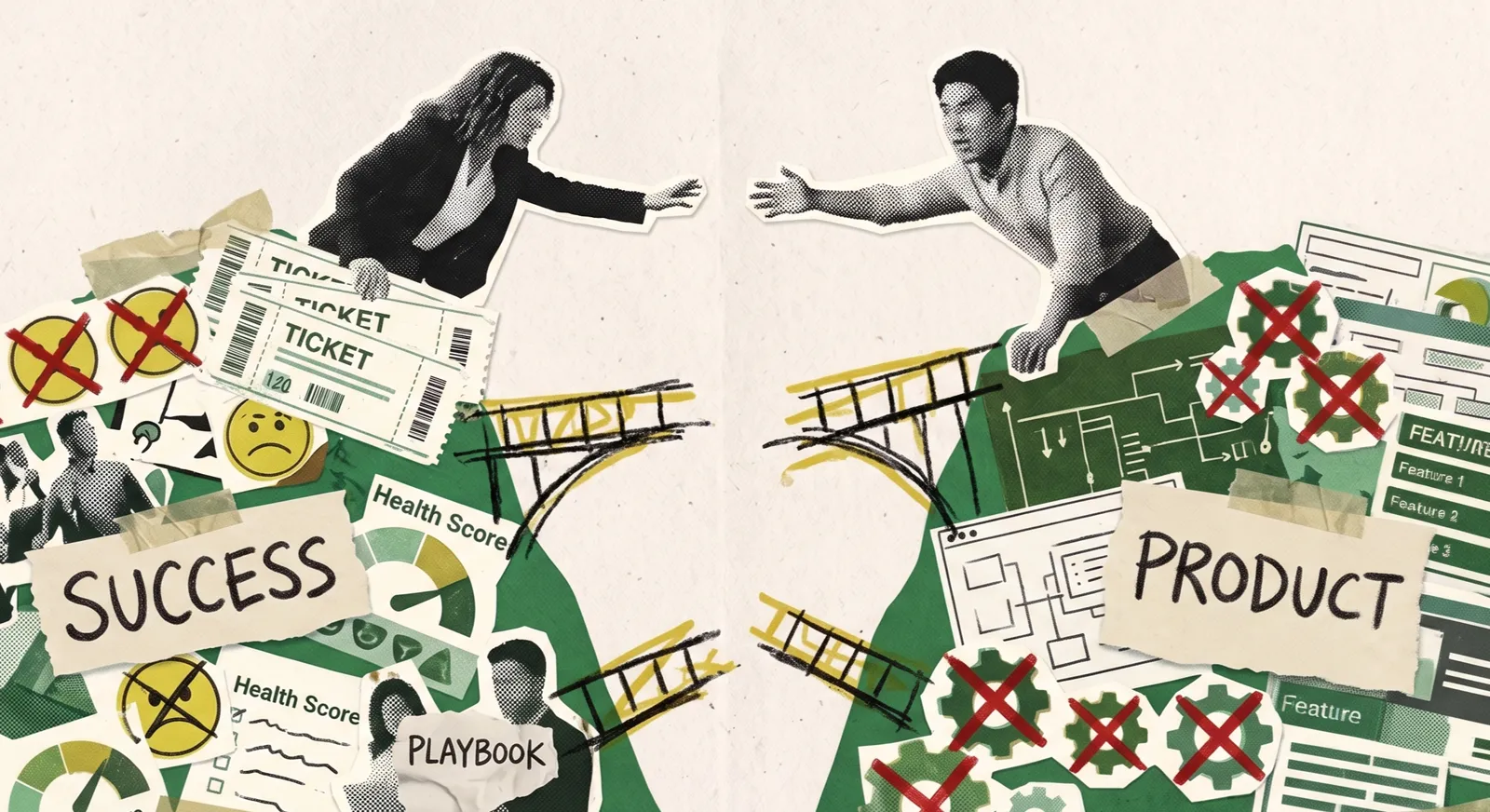
This is not a story about product teams being bad at prioritisation. It's a story about input quality, input source, and the structural disadvantage CS operates under when it tries to influence what gets built.
The power dynamic problem
Product teams are under constant input pressure. Sales wants features to close deals. Marketing wants capabilities to add to the messaging. Engineering has technical priorities. Customer support has bug reports. And CS has customer feedback, which, from the product manager's perspective, is real but often underdifferentiated and operationally difficult to process.
"Customers keep asking for X" is not a useful input to a product roadmap. Useful inputs look like: "here are the 23 accounts that have explicitly requested X, representing $4.2M ARR, and here is the specific workflow gap each of them is trying to close, supported by conversation excerpts and the business outcomes they're trying to achieve." That's a business case. "Customers keep asking" is a signal with no attached weight.
CS teams often feel frustrated that product doesn't listen to them. Product teams often feel frustrated that CS doesn't make their feedback actionable. Both sides are right.
The structural problem is that CS sits at the bottom of the influence hierarchy in most product organisations. Engineering has technical authority. Sales has commercial authority. Marketing has market positioning authority. CS has: relationship data, mostly, presented informally. That data is valuable, but the way it's typically presented doesn't compete with the other inputs in the room.
Why the feedback channel isn't enough
The standard solution (build a feedback channel between CS and product) is necessary but insufficient on its own.
The feedback channel creates a place for CS to put information. It doesn't create a mechanism for product to use that information systematically. It doesn't create a common language between the teams. It doesn't solve the weight problem: the question of how much a piece of customer feedback should move the needle on a roadmap decision.
The teams that have genuinely good CS-product relationships have something more structural than a channel. They have an agreed protocol for how customer evidence is compiled, presented, and evaluated. They have a named owner (usually in CS ops) who is responsible for the quality and format of product feedback, not just the volume of it. And they have a cadence that isn't "quarterly sync" but a more frequent, lower-stakes touchpoint that creates trust before the big roadmap conversation.
What product actually needs from CS
The most useful thing CS can do for product is not to surface more feedback. It's to surface better-qualified evidence.
A product manager making a prioritisation decision needs to know three things: how many customers are affected, how much that matters to their decisions, and what specifically they're trying to accomplish. The "how many" question is about prevalence. The "how much" question is about commercial weight. The "what specifically" question is about job-to-be-done.
CS teams have access to all three but rarely present all three together. Volume counts are easy to produce but low-signal. Commercial weight is available from the CRM but rarely attached to feature requests. Job-to-be-done (the specific workflow a customer is trying to complete, not the feature they're asking for) takes more work but is the most valuable input of the three.
A CS ops function that helps CSMs compile feedback in this format (aggregate it across accounts, weight it by ARR, translate "they want X" into "they're trying to accomplish Y and X is their proposed solution") is doing something product teams genuinely struggle to do for themselves. That's a real contribution. It's also something that creates a working relationship with product rather than a one-way request queue.
The escalation problem
One of the reasons CS loses influence is that it tends to escalate too broadly. Everything goes into the feedback channel. Nothing is prioritised before it arrives at product. So product receives an undifferentiated stream of requests and has to do the triage itself, which means applying their own criteria, which don't necessarily reflect the priorities that CS or the customer base would choose.
The better model is a pre-filtered escalation: CS does the prioritisation work before the request reaches product. The top three to five items that represent the highest combination of customer impact and commercial weight: those are what go into the formal roadmap input, presented as business cases. Everything else stays in the channel as background signal.
This is harder than logging everything. It requires CS ops to maintain a running view of what's most important, to defend those choices, and to hold back items that feel urgent to individual CSMs but aren't strategically significant at the portfolio level. That's a governance function, and one that requires CS to present itself as a credible voice, not a complaints department.
The executive sponsor question
The moment CS has the most legitimate influence on product is during an executive escalation, when a senior customer is unhappy and the CEO or CPO gets involved.
This is real leverage. It works. The feature gets built, or at least it gets expedited. And it's corrosive, because it teaches both product and CS that the right way to move the roadmap is through executive pressure rather than systematic evidence.
CS teams that rely on escalation as their primary product influence mechanism end up with a few highly visible wins and a large backlog of unaddressed feedback that will never move because it doesn't have an executive sponsor attached to it.
The long-term answer is structural: build the evidence-based influence process well enough that it doesn't require executive amplification. That means better-formatted input, a clearer prioritisation methodology, a trusted relationship with the product team, and the discipline to reserve escalation for situations that genuinely warrant it rather than using it as the default strategy.
The short version
CS struggles to influence product because its feedback is typically undifferentiated, under-weighted, and arrived without a common format that product can use. "Customers keep asking" doesn't move roadmaps. "23 accounts representing $4.2M ARR need this specific workflow capability for these reasons" might.
The structural fix: assign CS ops to own the quality of product feedback, not just the volume. Compile aggregate evidence with commercial weight and job-to-be-done framing. Pre-prioritise before escalation so product receives a short, qualified business case rather than a long, undifferentiated request queue. Build a cadence with product that's more frequent than quarterly and lower-stakes than the formal roadmap review.
The cultural fix: stop using executive escalation as the default lever. It works in the short term and undermines the structural relationship in the long term.
Where Pivotal Path comes in
If your CS team has a feedback channel nobody takes seriously, the problem is almost certainly presentational rather than substantive. We help CS leaders build the evidence infrastructure that makes product influence structural rather than incidental.
Working on this in your business?
We help UK SMEs and scale-ups turn this kind of thinking into action.
Read next

When Sales and CS share the same customer: the commercial ownership problem

Defining Success Before the Sale: The CS Conversation That Usually Starts Too Late

The Sales-to-CS Handover Is Broken, and Both Teams Know It
CS and Product: Closing the Feedback Loop That Usually Stays Open

Voice of Customer Is Broken at Most SaaS Companies: Here's Why